Several years ago I was contacted by someone with the Clackamas County Historical Society about Christopher Carll Robbins, a noted Portland area architect. In fact, Robbins had designed the Stevens-Crawford Heritage House in Oregon City which is one of the museums run and maintained by the historical society. Then began some research into his life and some of his architectural accomplishments.
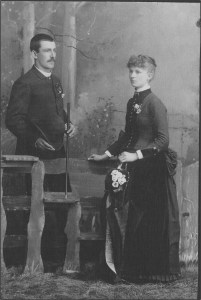
Chris Robbins was a son of Nathaniel Norval and Permelia Ann (Bird) Robbins, and a grandson of Nathaniel and Nancy Robbins. He was born in 1866 in Stafford, Oregon, just to the northwest of present-day Wilsonville, and was married to Anna Holcomb in 1887 with his brother Oren Decatur Robbins as one of the witnesses.
In 1887 C. C. and Anna Robbins appear in Seattle, Washington, in a state census. Chris is listed as a 21-year-old machinist. Anna is 19. They are listed there again in 1889. Since the 1890 federal census hasn’t survived it is nice to have at least these state censuses to locate our family members between 1880 and 1900.
In an interview with the noted Oregon journalist Fred Lockley he reminisced about his background:
“When I was 17 [c1883] I came to Portland and secured work in a sash and door factory owned by J. C. Carson. I followed that trade for the next 21 years, meanwhile studying architecture. In my late 30s I hung out my shingle as an architect, since which time I have planned and built hundreds of houses in Portland.” (“Observations of a Journal Man,” Oregon Journal, 9 December 1933)
An undated photograph of the employees of the J. C. Carsons’ Sash and Door Factory in Portland shows C. C. Robbins in the top row, second from the right, and listed as a “machine hand” which is also the occupation he is listed as in the 1900 census. Perhaps the photo was taken around the same time.
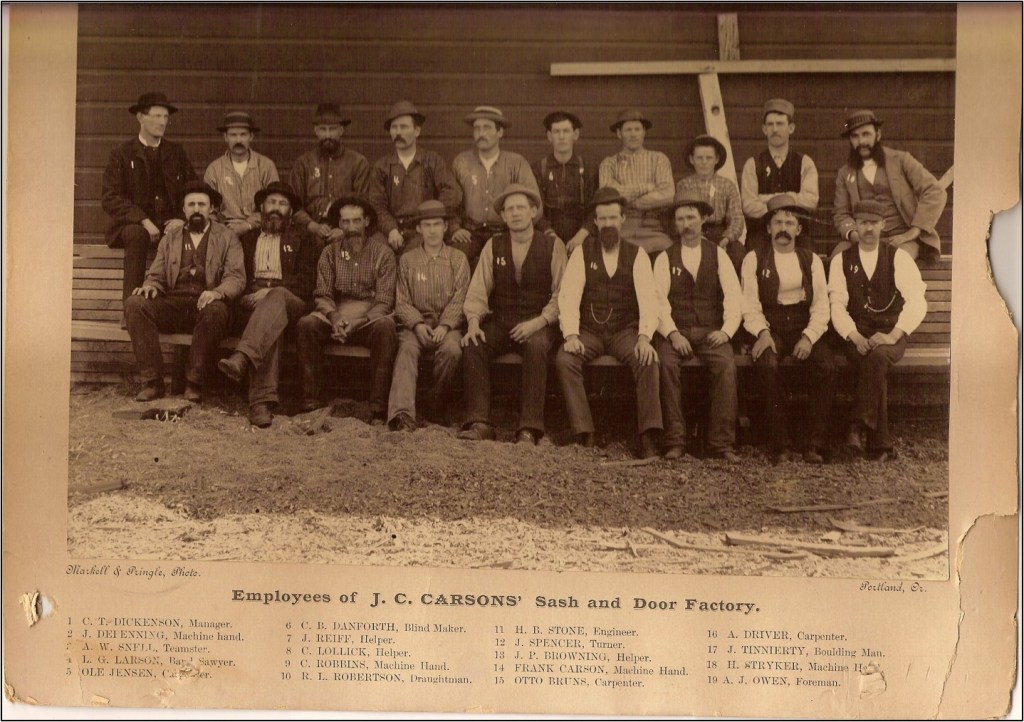
He mentions “studying” architecture but I don’t know if he received formal schooling or read and studied architecture from books and observing others. In the early 1900s he begins to show up in newspaper articles as being an architect and designer of houses and buildings. A foreman of the Carson Sash and Door Factory, Holly A. Cornell, went on to be an architect in the 1890s. Perhaps Chris followed the same path: machinist to architect? In the 1910 census his occupation is given as “architect” as it was for the following census years of 1920 and 1930. His death certificate listed him as a “builder.”
Another excerpt from his interview by Fred Lockley:
“In 1896 Mr. Hubbard, superintendent of the fish hatcheries in Oregon at that time, employed me to build a fish hatchery on the Little White Salmon. The hatchery was located about a mile and a half above the mouth of the Little White Salmon. When we had the fish racks and traps built a large number of Klickitat Indians came down for their yearly salmon catch. They were very much upset at the sight of the racks and traps. They threatened to tear out the racks. John Talbot of Clackamas was in charge of the fish-taking gang. He wanted us to get out our guns and shoot the first Indian that touched a salmon or bothered the fish traps. I finally persuaded him that it would simply mean that the Indians would wipe us out if we shot them. There were 17 white men and several hundred Indians. I persuaded Talbot to send word to the military authorities at Vancouver. An officer came up and held a pow-wow with the chief of the Klickitats. The difficulty was settled by our turning over to the Indians all of the salmon after the eggs had been extracted. They never had so many fish in their lives. They gave us arrow points, moccasins and buckskin gloves and offered us dried salmon.”
I was not able to find contemporaneous confirmation of this story at White Salmon (which is located on the north side of the Columbia River in Washington State) though I did find an article from 1896 where W. F. Hubbard, superintendent of the fish hatchery on the Clackamas river, discusses the number of salmon hatched that year and that “the upper Clackamas hatchery is a success and that the Indians do not distrust the fish in the upper river now, much preferring to take the fish after same have been relieved of the eggs by the hatchery people…” (Oregon Courier, Oregon City, Ore., 8 May 1896).
The earliest newspaper mention I can find of Chris Robbins is in 1899, when the McMinnville, Oregon, newspaper, The Yamhill County Reporter, mentions that: “Chas. P. Nelson has the draft for his new residence, fresh from the pen of Mr. Robbins, the architect. It will be a very neat residence, and will cost about $900.”
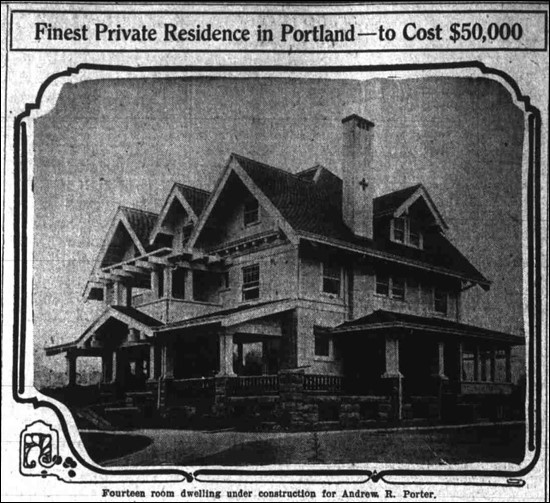
Some of the existing buildings he is credited with designing include Roswell Conner House in McMinnville (1905), Oregon City Masonic Lodge (1907), and the Masonic Building in McMinnville (1913). This information is obtained from the Oregon Historic Site Records of the Oregon Historic Preservation Office.
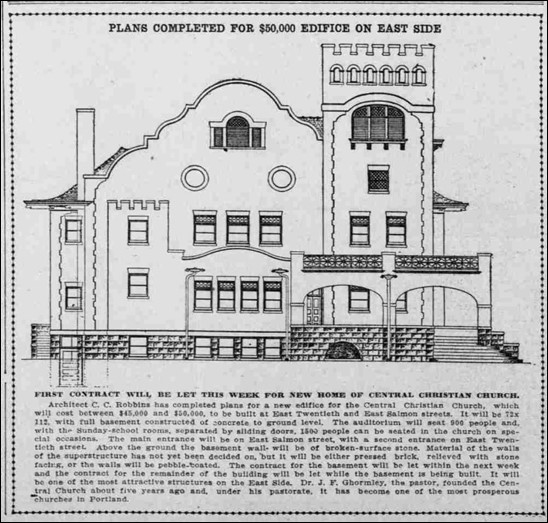
More information comes from numerous newspaper articles such as: “Architect C. C. Robbins has completed plans for a new edifice for the Central Christian Church, which will cost between $45,000 and $50,000, to be built at East Twentieth and East Salmon Streets.” (see drawing below) (Sunday Oregonian, 12 July 1908, sec. 3, p. 4, col. 3-6)
There is also mention of a home being built for the Robbins family and you must wonder if Chris didn’t design it himself: “A handsome 2½-story dwelling is being built for C. C. Robbins at East Twentieth and Everett Streets. The cost will be about $3,000.” (Oregon Daily Journal, 15 April 1906, sec. 2, p. 32, col. 4)
We also find this news article: “House Burglarized – Jewelry of the value of about $150 was taken from the home of C. C. Robbins 67 East Twentieth street north, yesterday afternoon, while Mr. Robbins and other members of the family were at the automobile races. Entrance to the home was gained by breaking a plate glass in the side door.” (Oregon Daily Journal, 10 July 1912, p. 9, col. 2)

Later in 1916 Chris has added more to his resume: “C. C. Robbins, architect, has joined J. H. Hill and is engaged in the manufacture of billiard, pool and bowling alley supplies and ivory, fiber and wood novelties at 302 Pine Street.” (Oregon Daily Journal, 21 Oct. 1916, p. 9, col. 4-5).

Chris and his wife Anna were the parents one son, Archie Robbins. About his son Chris told Fred Lockley: “My son, Archie, is an expert toolmaker. His health became wrecked while in the service during the World war and he is in the veterans’ hospital at American Lake [Washington].” Sadly, Archie was a pedestrian struck and killed by a car in Tenino, Washington, in 1939.
Christopher Robbins died in January of 1943 and Anna did not long outlive him, dying six months later in June. Both are buried in Lincoln Memorial Park in Portland.
[Jacob Robbins-William Robbins-Nathaniel Robbins-Nathaniel Norval Robbins-Christopher Carll Robbins]

 Robbins Roots